How to Build a Standout Tech Resume in 2026
SkillVeris Team
Careers Team
A strong tech resume passes the ATS, proves impact with numbers, and shows your work through project and GitHub links.
In this guide, you'll learn:
- Most resumes are rejected by an Applicant Tracking System before a human ever reads them.
- Keep it to one page under 5 years of experience and two pages maximum after that.
- Write experience bullets as action + result + scale, not lists of job duties.
- Mirror the job description's exact keywords and capitalisation in your Skills and Experience sections.
1Why Most Resumes Fail
The average tech job listing receives hundreds of applications. Most companies use an Applicant Tracking System (ATS) to filter them before a human ever reads them. The majority of resumes are rejected at this stage — not because the candidate is unqualified, but because the resume wasn't written for how the ATS parses it.
The other common failure is listing job duties instead of achievements. Recruiters who do read your resume want to know what you accomplished — not what your job description said.
2How ATS Works
An ATS parses your resume into a structured database and scores it against the job description — primarily by keyword matching. There are several things it simply cannot read reliably.
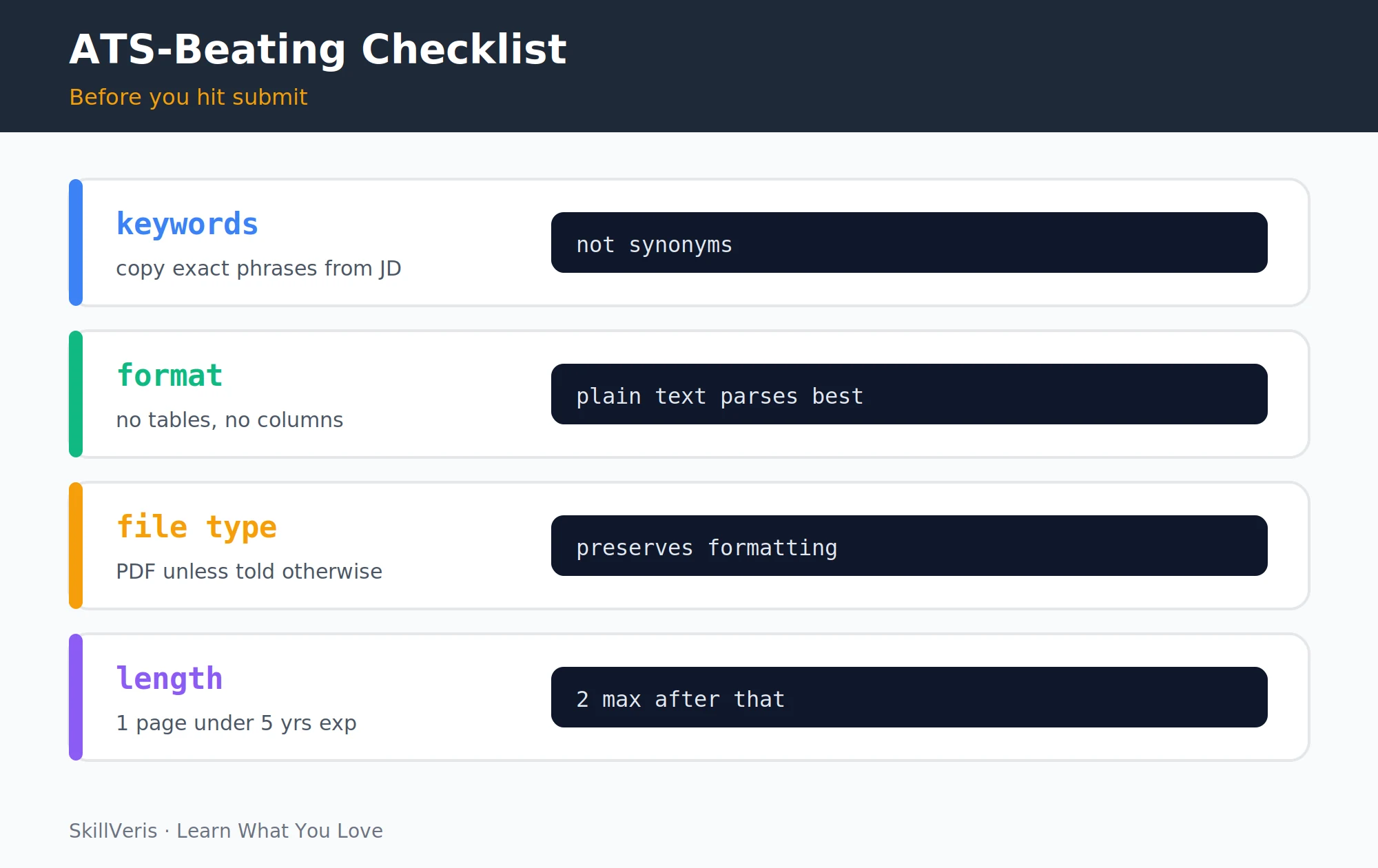
The safest format is a single-column layout with standard section headings (Experience, Education, Skills), clean fonts, and the file exported as PDF.
- Text inside tables or multiple columns — it often scrambles the order.
- Text placed in headers and footers.
- Graphics, icons, or images.
- Fancy fonts or non-standard characters.
3The Right Format
Recruiters skim rather than read in full, so length and formatting choices matter as much as content. A few simple rules keep your resume both human-readable and ATS-parseable.
- Length: one page for under 5 years of experience; two pages maximum after that. Recruiters skim — they don't reward length.
- Font: Calibri, Helvetica, or Georgia at 10–11pt. No novelty fonts.
- Margins: 0.75–1 inch. Narrower looks cramped; wider wastes space.
- File type: PDF preserves formatting. Use .docx only when the job posting specifically requests it.
- File name: FirstName_LastName_Resume.pdf — not resume_final_v3.pdf.
4The Summary Section
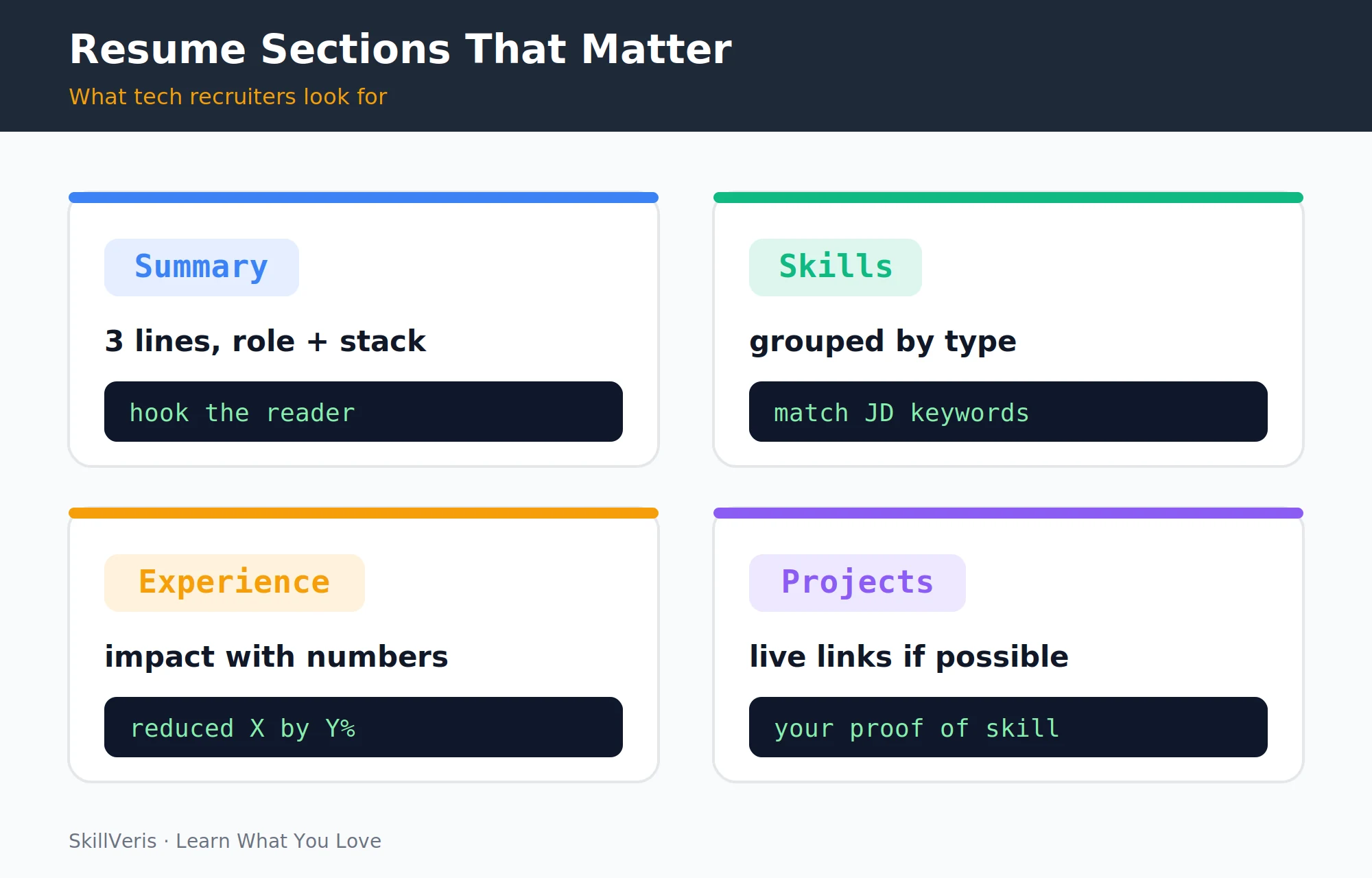
A 2–3 line summary at the top tells the recruiter immediately who you are and what you bring. It's optional for experienced candidates but valuable for career changers and fresh graduates.
A bad summary reads: "Passionate developer with excellent communication skills looking for a challenging role." A good one reads: "Full-stack developer with 2 years building Python/React applications. Shipped three production features serving 10,000+ users. Seeking a backend engineering role in a product-led company."
The good version mentions a stack, quantifies experience, and states a goal. The bad version says nothing specific.
5The Skills Section
Group skills by type for scannability so a recruiter can find what they need at a glance. Only list skills you can discuss in an interview — claiming "Machine Learning" because you finished one tutorial will backfire when an interviewer asks about it.
- Languages: Python, JavaScript, SQL, Bash
- Frameworks: React, FastAPI, Django, Node.js
- Cloud & DevOps: AWS, Docker, Kubernetes, Terraform, GitHub Actions
- Tools: Git, PostgreSQL, Redis, Jira
💡Pro Tip
Copy the exact phrasing from the job description for your core skills. If the JD says "React.js" and your resume says "ReactJS," the ATS may not match them. Use the employer's exact capitalisation and spelling.
6Writing Experience Bullets
Each bullet should follow the action + result + scale formula. Swapping vague duties for concrete outcomes is the single biggest improvement most resumes can make.
If you don't have exact numbers, estimate conservatively: "improved performance by approximately 30%", or "supported a team of 5 developers."
- Responsible for backend APIs → Built REST APIs in FastAPI that reduced page load time by 40% for 25k daily active users
- Worked on CI/CD pipelines → Migrated manual deployments to GitHub Actions, reducing release time from 2 hours to 12 minutes
- Helped with database optimisation → Rewrote 3 slow SQL queries, cutting average report generation from 45s to 3s
7The Projects Section
For junior developers, projects often matter more than experience. For each project, include a one-line description of what it does, the stack used, a live or GitHub link (if public), and one notable technical detail or scale metric.
Example: "RailVeris AI — Android railway companion app with 8,697-station dataset, fare calculator, and on-device AI journey planner. Built in Kotlin/Jetpack Compose. 500+ installs." Then a GitHub or Play Store link.
⚠️Watch Out
A private GitHub repository linked on a resume looks worse than no link at all. Make portfolio projects public, add a README, and ensure the code is clean before sharing the link.
8Education and Certifications
List your degree, institution, and graduation year. Keep this section short and relevant rather than exhaustive.
- List degree, institution, and graduation year. GPA only if 3.5+ and recently graduated.
- Relevant certifications (AWS, Google, CompTIA) go here or in a separate Certifications section.
- Online courses (Coursera, Udemy) are fine to list if they're substantial and relevant, but don't pad with dozens of completions.
9Tailoring for Each Job
A generic resume performs worse than a tailored one in ATS scoring. For each application, follow a short, repeatable process.
This takes 10–15 minutes per application and significantly improves pass-through rates.
- Read the job description and highlight the required and preferred skills.
- Ensure those exact terms appear in your Skills and Experience sections.
- Reorder bullet points so the most relevant experience comes first.
- Adjust the summary to mirror the role's title and primary requirement.
10What NOT to Include
Some resume conventions are outdated and actively hurt you. Cutting them frees up space for the content that actually wins interviews.
- Photo: not expected in most tech markets (US, UK, India) and can introduce bias.
- Date of birth, marital status, religion: irrelevant and can introduce bias.
- Objective statement: replaced by the Summary; objectives focus on what you want, not what you offer.
- "References available on request": wastes space; it's assumed.
- Unrelated experience from 10+ years ago: unless it demonstrates a transferable skill directly relevant to the role.
11Free Tools That Help
A handful of free tools can sharpen your resume before you submit it, from ATS scoring to clean templates and grammar checks.
- Jobscan.co — scores your resume against a job description for ATS match
- Resume.io / Canva — clean, ATS-friendly templates
- Grammarly — catches typos and grammar errors
- LinkedIn Resume Builder — auto-generates from your LinkedIn profile
12Key Takeaways
Pulling it together, a standout tech resume is engineered for both the ATS and the recruiter who reads it next.
- Format for the ATS: single column, standard headings, PDF, no tables or graphics.
- Use the job description's exact keywords in your Skills and Experience sections.
- Write bullets as action + result + scale — not duty lists.
- Link to public projects; keep GitHub repos clean and documented.
- Tailor for every application — 15 minutes per job, not a generic blast.
13What to Learn Next
Complete your job-search toolkit with these companion guides.
- How to Build a Developer Portfolio — projects to put on the resume.
- LinkedIn Tips for Developers — make recruiters come to you.
- How to Switch to a Tech Career in 6 Months — the full transition plan.
14Frequently Asked Questions
Should my tech resume be one page or two? One page for under 5 years of experience; two pages maximum for more. Recruiters prefer concise over comprehensive — if in doubt, cut it down.
Do I need a cover letter? Not always, but a well-written cover letter can differentiate you when the role is competitive or when you're making a career change. If a cover letter is optional, write one — most candidates don't.
Can I use a creative or designed resume template? Only if you're applying to design roles where visual presentation is part of the evaluation. For most tech roles, clean and ATS-parseable beats visually impressive — the ATS doesn't appreciate your typography choices.
How important is a GitHub profile on a resume? Very. For developer roles especially, a GitHub with active, well-documented projects is often weighted as heavily as formal experience. Pin your best 6 repositories and add READMEs to each.
Get The Print Version
Download a PDF of this article for offline reading.
About the Publisher
SkillVeris Team
Careers Team
Our careers team helps you navigate tech job markets, build portfolios, and land the roles you want.
View all postsRelated Posts
Never miss an update
Get the latest tutorials and guides delivered to your inbox.
No spam. Unsubscribe anytime.