Large Language Models (LLMs) Explained for Beginners
SkillVeris Team
AI Research Team
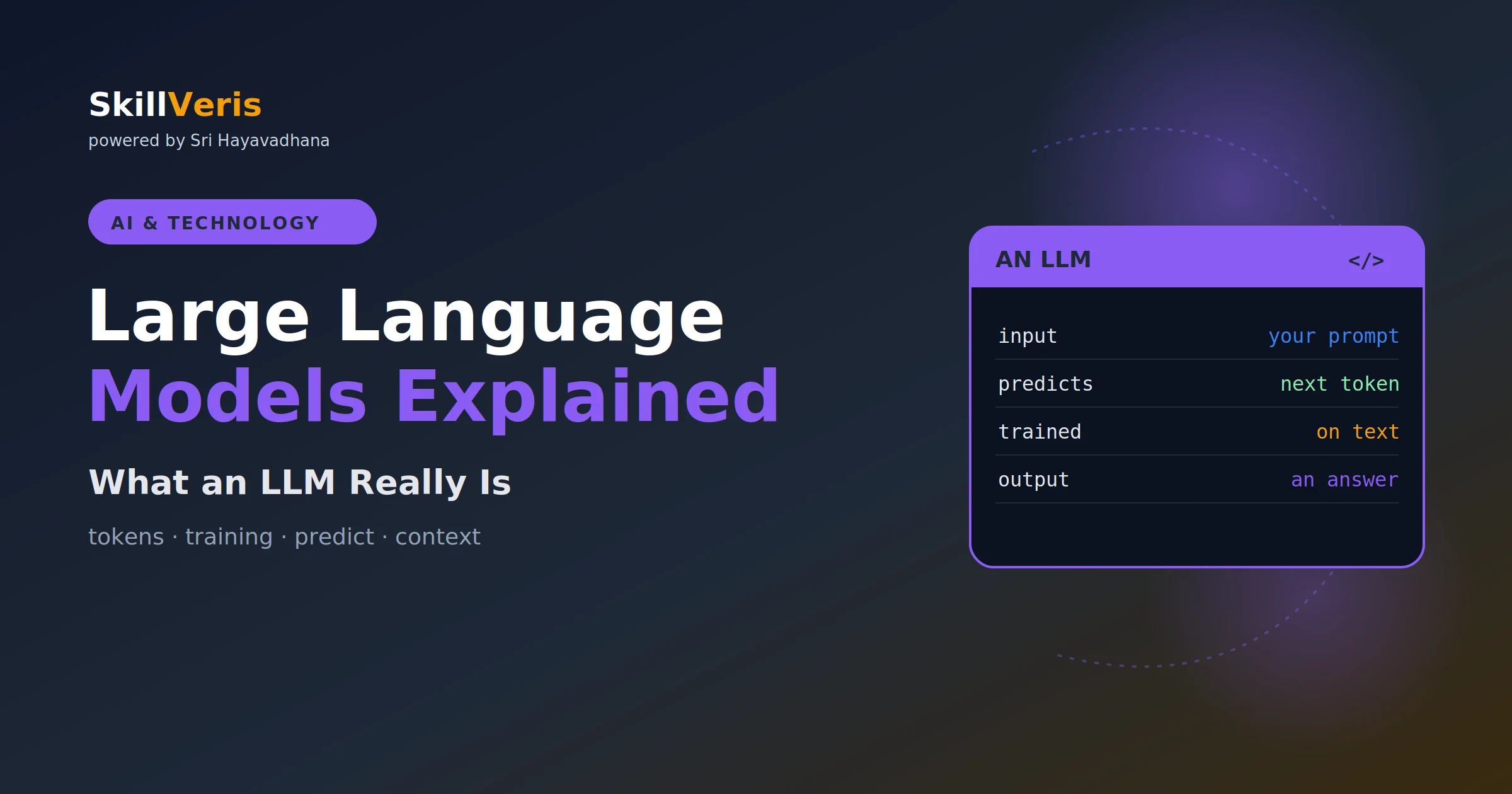
An LLM is a system trained on enormous amounts of text to do one core thing: predict the next piece of text
In this guide, you'll learn:
- It breaks language into tokens, learns patterns during training, and generates answers one token at a time
- It's powerful at language, but predicts patterns rather than truly 'understanding'.
- All concepts are explained with real-world examples and hands-on practice.
- All concepts are explained with real-world examples and hands-on practice.
1About This Guide
You use LLMs every time you chat with an AI assistant — but how do they actually work? This guide
demystifies them without any maths. By the end you'll understand what an LLM is, how it generates text,
2What Is an LLM?
billions of internal settings; "Language Model" because its job is to model how language works. ChatGPT,
3The One Thing an LLM Does
Underneath the impressive conversations, an LLM does something surprisingly simple: it predicts the
next piece of text. Given what's come so far, it guesses what should come next — then again, and
4Tokens: How AI Sees Text
An LLM doesn't read whole words the way we do. It breaks text into tokens — small chunks that may be
whole words or parts of words. "Learning" might be one token; an unusual word might be split into
5Training: Learning From Text
During training, the model reads vast amounts of text and repeatedly tries to predict the next token,
adjusting its internal settings each time it's wrong. Over billions of examples, it absorbs the patterns of
6Prediction in Action
When you type a prompt, the model predicts the most fitting next token, adds it, then predicts the next,
and so on. It feels like the AI is "thinking", but it's generating a likely continuation of your text, token by
7The Context Window
The context window is how much text the model can consider at once — its short-term working
memory. A larger window lets it handle long documents or conversations without losing track. Once
- Writing, summarising, and rephrasing text.
- Explaining concepts and answering questions.
- Drafting and reviewing code.
- Adapting tone, style, and format on request.
- Guarantee accuracy — always verify facts and figures.
Related Reading
Get The Print Version
Download a PDF of this article for offline reading.
About the Publisher
SkillVeris Team
AI Research Team
Our AI team covers the latest in machine learning, generative AI, and emerging tech — clearly and accurately.
View all postsRelated Posts
Never miss an update
Get the latest tutorials and guides delivered to your inbox.
No spam. Unsubscribe anytime.