Natural Language Processing (NLP) for Beginners
SkillVeris Team
AI Research Team
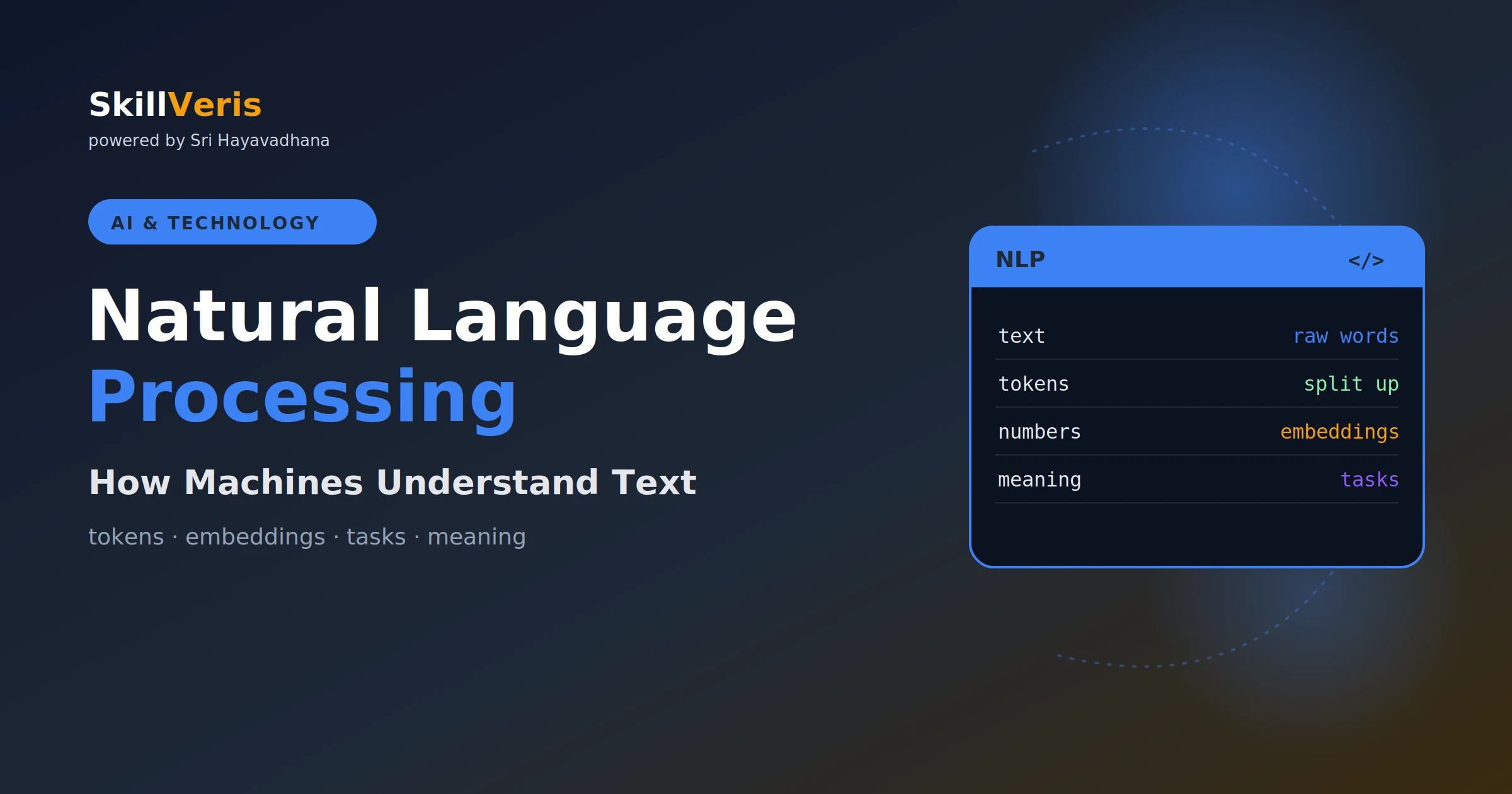
NLP is AI for human language
In this guide, you'll learn:
- Because computers need numbers, NLP turns text into tokens, then into embeddings (vectors that capture meaning), which models use for tasks like sentiment analysis, translation, su
- Modern NLP is powered by large language models.
- All concepts are explained with real-world examples and hands-on practice.
- All concepts are explained with real-world examples and hands-on practice.
1About This Guide
Every time you search, translate, or chat with an assistant, NLP is at work. This guide explains how
machines handle human language, step by step and without maths. By the end you'll understand tokens,
2What Is NLP?
Natural Language Processing is the branch of AI that lets computers read, understand, and generate
human language. It bridges the gap between how we communicate — messy, ambiguous words — and
3Why Language Is Hard for Computers
Language is full of ambiguity, context, sarcasm, and exceptions. "I'm dying to see it" isn't about dying.
The same word means different things in different sentences. Teaching machines to handle this nuance
4Step 1: Tokens
First, text is broken into tokens — small chunks, usually words or word-parts. "Learning" might be one
token; a rare word might split into several. Tokens are the basic units NLP systems work with.
5Step 2: Embeddings (Words as Numbers)
Computers need numbers, so each token becomes an embedding — a list of numbers (a vector) that
captures its meaning. The clever part: words with similar meanings get similar vectors, so "king" and
6Common NLP Tasks
This section provides key insights and practical guidance.
- Sentiment analysis — is this text positive or negative?
- Translation — convert between languages.
- Summarisation — shorten long text.
- Named entity recognition — find names, places, dates.
- Question answering and chatbots — understand and respond.
7Sentiment Analysis
One of the most common tasks: deciding whether text expresses positive, negative, or neutral feeling.
Businesses use it to analyse reviews and social media at scale — impossible to do by hand across
- Search engines understanding your queries.
- Voice assistants and chatbots.
- Email spam filters and smart replies.
- Translation apps and autocomplete.
- Learn Python and basic machine learning.
Related Reading
Get The Print Version
Download a PDF of this article for offline reading.
About the Publisher
SkillVeris Team
AI Research Team
Our AI team covers the latest in machine learning, generative AI, and emerging tech — clearly and accurately.
View all postsRelated Posts
Never miss an update
Get the latest tutorials and guides delivered to your inbox.
No spam. Unsubscribe anytime.