Python Functions Explained for Beginners
SkillVeris Team
Engineering Team
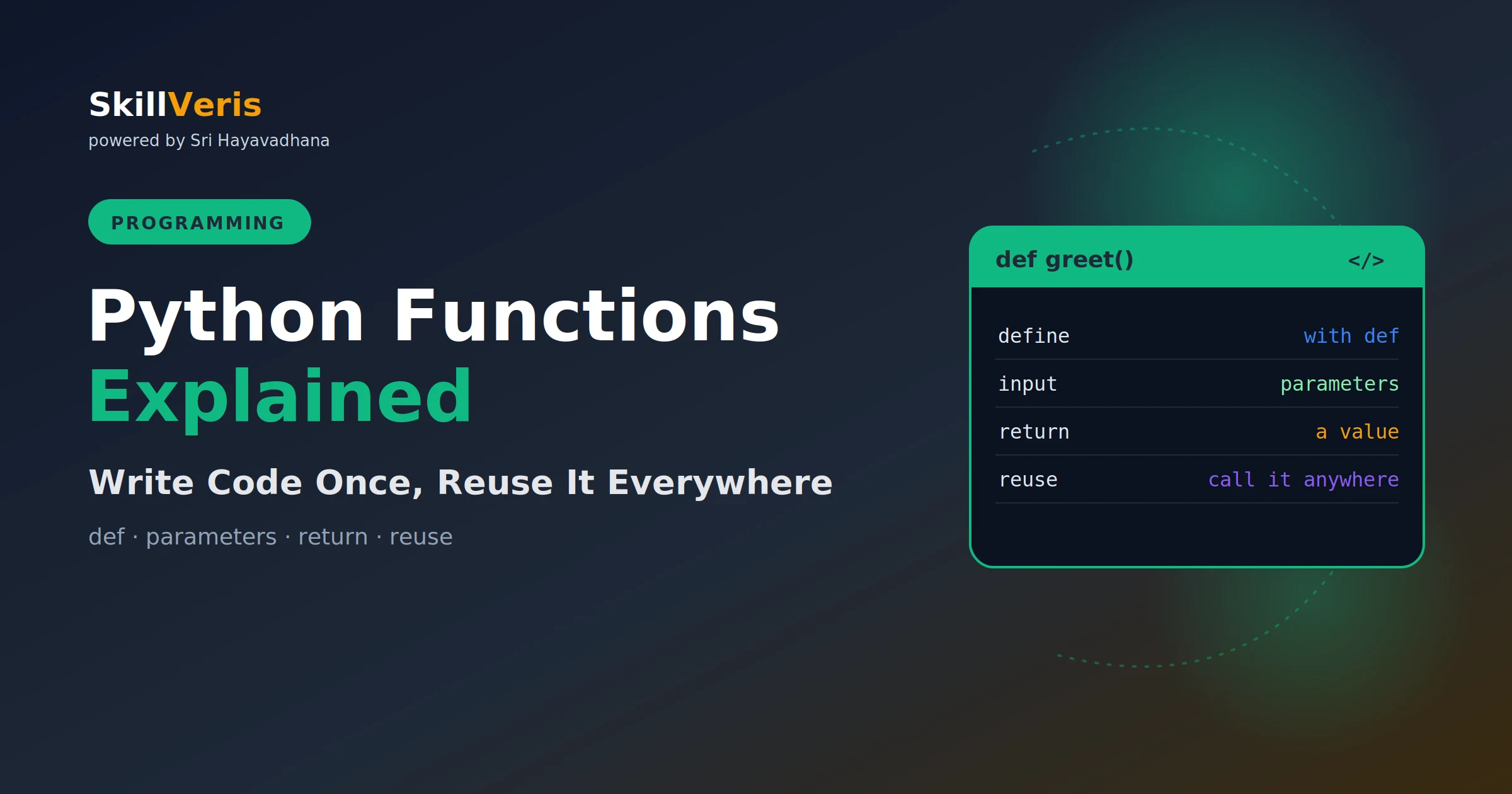
A function is a named, reusable block of code
In this guide, you'll learn:
- You define it with def , give it parameters (inputs), run its body, and optionally return a value
- Functions keep code DRY — write it once, call it anywhere — and are the backbone of every real program.
- All concepts are explained with real-world examples and hands-on practice.
- All concepts are explained with real-world examples and hands-on practice.
1About This Guide
Once you've learned variables and loops, functions are the next big step — they're how programs stay
organised and reusable. By the end of this guide you'll be able to:
- Define and call your own functions.
- Pass inputs and return outputs.
- Use default, keyword, and variable arguments.
- Avoid the classic beginner pitfalls.
2What Is a Function?
A function is a named block of code that does one job. You define it once, then "call" it whenever you
need that job done — like a recipe you can follow again and again without rewriting it.
3Why Use Functions?
The parts of a Python function: def, parameters, body, return
- Reuse — write logic once, use it everywhere (the "DRY" principle: Don't Repeat Yourself).
- Clarity — a good function name explains what code does.
- Easier fixes — change the logic in one place, not ten.
4Defining and Calling a Function
Use def , a name, parentheses, and a colon; the indented lines below are the function's body. Calling it
5Parameters and Arguments
Parameters are the inputs a function accepts; arguments are the actual values you pass in.
6Return Values
Functions can send a value back with return , so you can use the result elsewhere. Without return , a
7Default and Keyword Arguments
Types of Python function arguments: positional, keyword, default, variable
Sometimes you don't know how many arguments will come. *args collects extra positional values;
- Forgetting to call the function (writing greet instead of greet() ).
- Forgetting return when you need the result — you'll get None .
- Using a mutable default like def f(items=[]) — it's shared across calls; use None instead.
- Doing too much in one function — keep each focused on a single job.
- Functions are named, reusable blocks defined with def .
Related Reading
Get The Print Version
Download a PDF of this article for offline reading.
About the Publisher
SkillVeris Team
Engineering Team
Our engineering writers turn abstract code concepts into hands-on, project-driven learning experiences.
View all postsRelated Posts
Never miss an update
Get the latest tutorials and guides delivered to your inbox.
No spam. Unsubscribe anytime.