RAG Explained: How AI Answers From Your Data
SkillVeris Team
AI Research Team
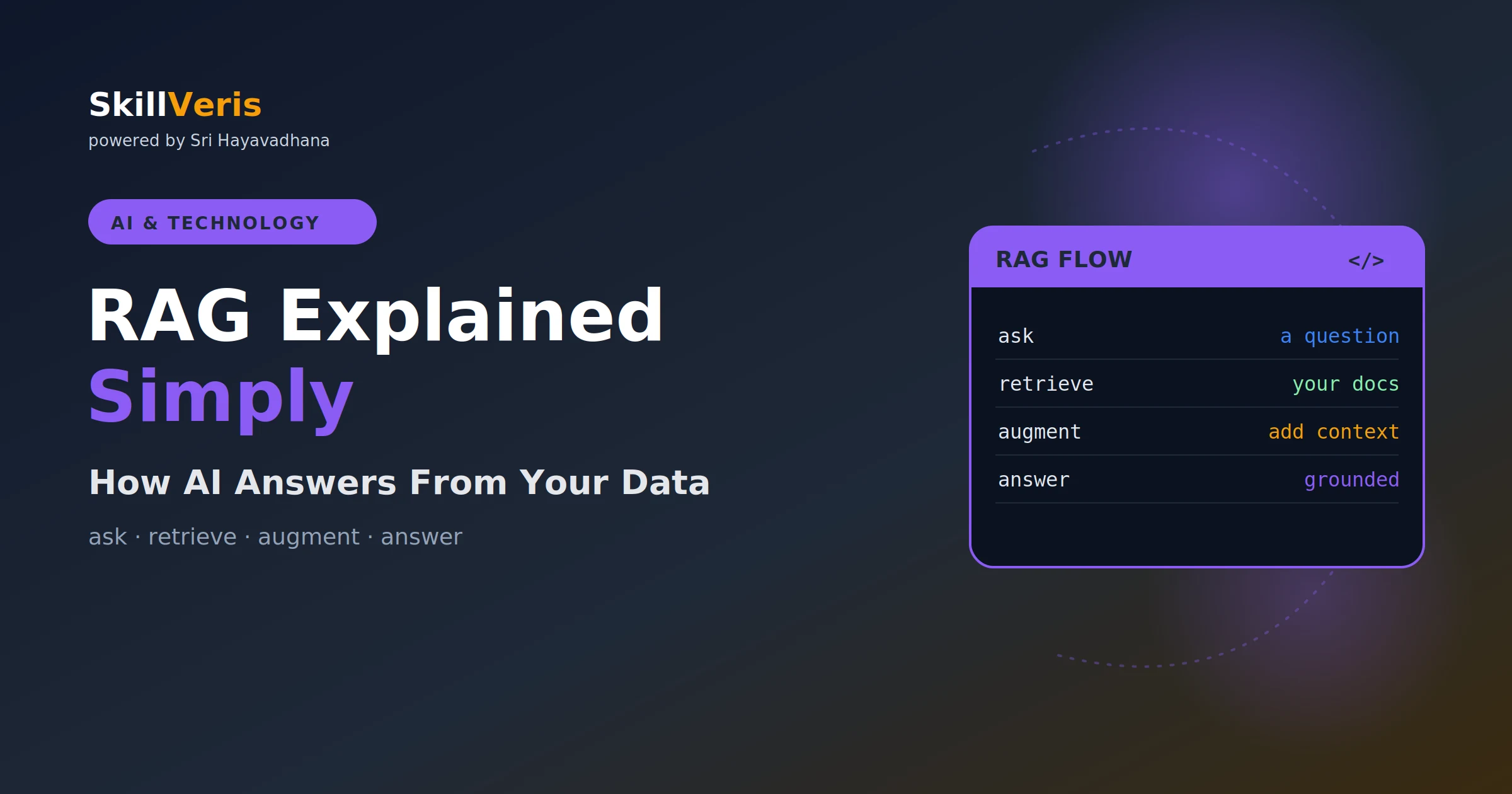
RAG (Retrieval-Augmented Generation) lets an AI answer from your data
In this guide, you'll learn:
- Instead of relying only on what it learned in training, it first retrieves relevant documents, adds them to the prompt (augment), then generates a grounded answer — reducing halluc
- All concepts are explained with real-world examples and hands-on practice.
- All concepts are explained with real-world examples and hands-on practice.
- All concepts are explained with real-world examples and hands-on practice.
1Collect your documents and split them into chunks.
This section provides key insights and practical guidance.
2Create embeddings and store them in a vector database.
This section provides key insights and practical guidance.
3On a question, retrieve the most relevant chunks.
This section provides key insights and practical guidance.
4ANSWER the model replies using that context (and can cite it)
This section provides key insights and practical guidance.
5How Retrieval Works
The retrieval step usually uses embeddings. Your documents are converted into vectors (numbers that
capture meaning) and stored in a vector database. When a question comes in, it's also turned into a
6Why RAG Helps
This section provides key insights and practical guidance.
- Accuracy — answers are grounded in real documents, reducing hallucinations.
- Freshness — update the documents and answers update too, no retraining.
- Sources — the model can cite where its answer came from.
- Privacy — it works with your own data without baking it into the model.
7RAG vs Fine-Tuning
People often confuse the two. RAG looks information up at answer time — ideal for facts and documents
that change. Fine-tuning bakes knowledge or style into the model itself — better for changing behaviour
- Chatbots that answer from a company's help docs or policies.
- Search assistants over internal knowledge bases.
- Tools that answer questions about long PDFs or contracts.
- Customer support grounded in product documentation.
- Garbage in, garbage out — answers are only as good as the documents.
Related Reading
Get The Print Version
Download a PDF of this article for offline reading.
About the Publisher
SkillVeris Team
AI Research Team
Our AI team covers the latest in machine learning, generative AI, and emerging tech — clearly and accurately.
View all postsRelated Posts
Never miss an update
Get the latest tutorials and guides delivered to your inbox.
No spam. Unsubscribe anytime.