Top Tech Trends to Watch in 2026
SkillVeris Team
Editorial Team
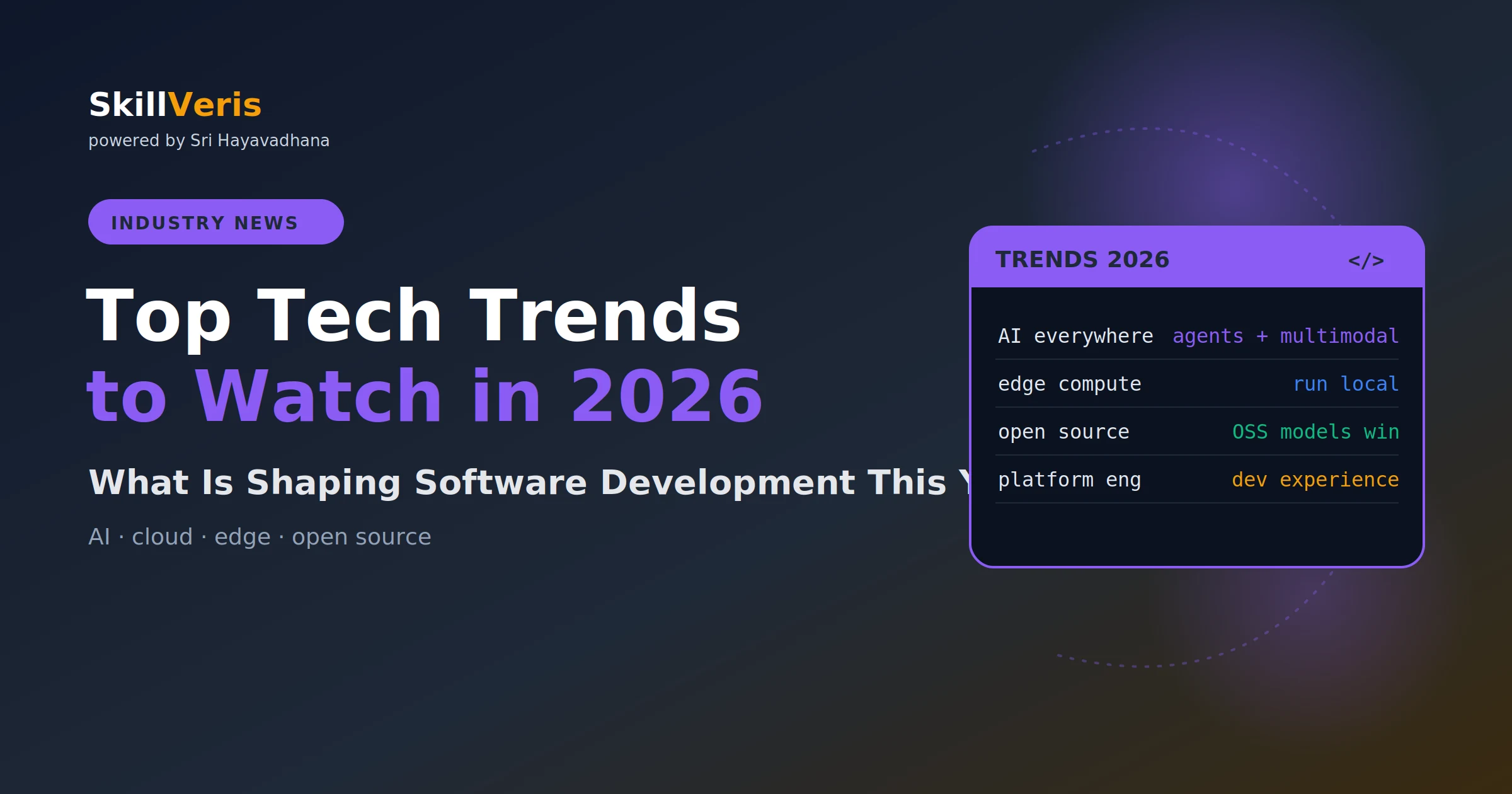
The defining tech shifts of 2026 are AI agents in production, on-device AI, open-source models reaching parity, and platform engineering becoming standard.
In this guide, you'll learn:
- Developers who understand AI integration and DevOps will be the most in demand.
- AI agents have moved from answering questions to autonomously completing multi-step tasks.
- On-device and open-source models give teams real, privacy-preserving alternatives to proprietary APIs.
- Evaluation engineering is emerging as a distinct discipline as AI systems move into production.
1How to Think About Tech Trends
Not all trends deserve equal attention. Some are genuine shifts in how software is built (containerisation in 2015, cloud in 2010); others are hype cycles that peak and recede (blockchain for everything, Web3).
The useful filter: does this trend create or destroy concrete jobs, change the tools you use daily, or open new product categories? The trends below are grounded in deployment data, hiring signals, and observable shifts in engineering practice — not VC narratives.
2Trend 1: AI Agents in Production
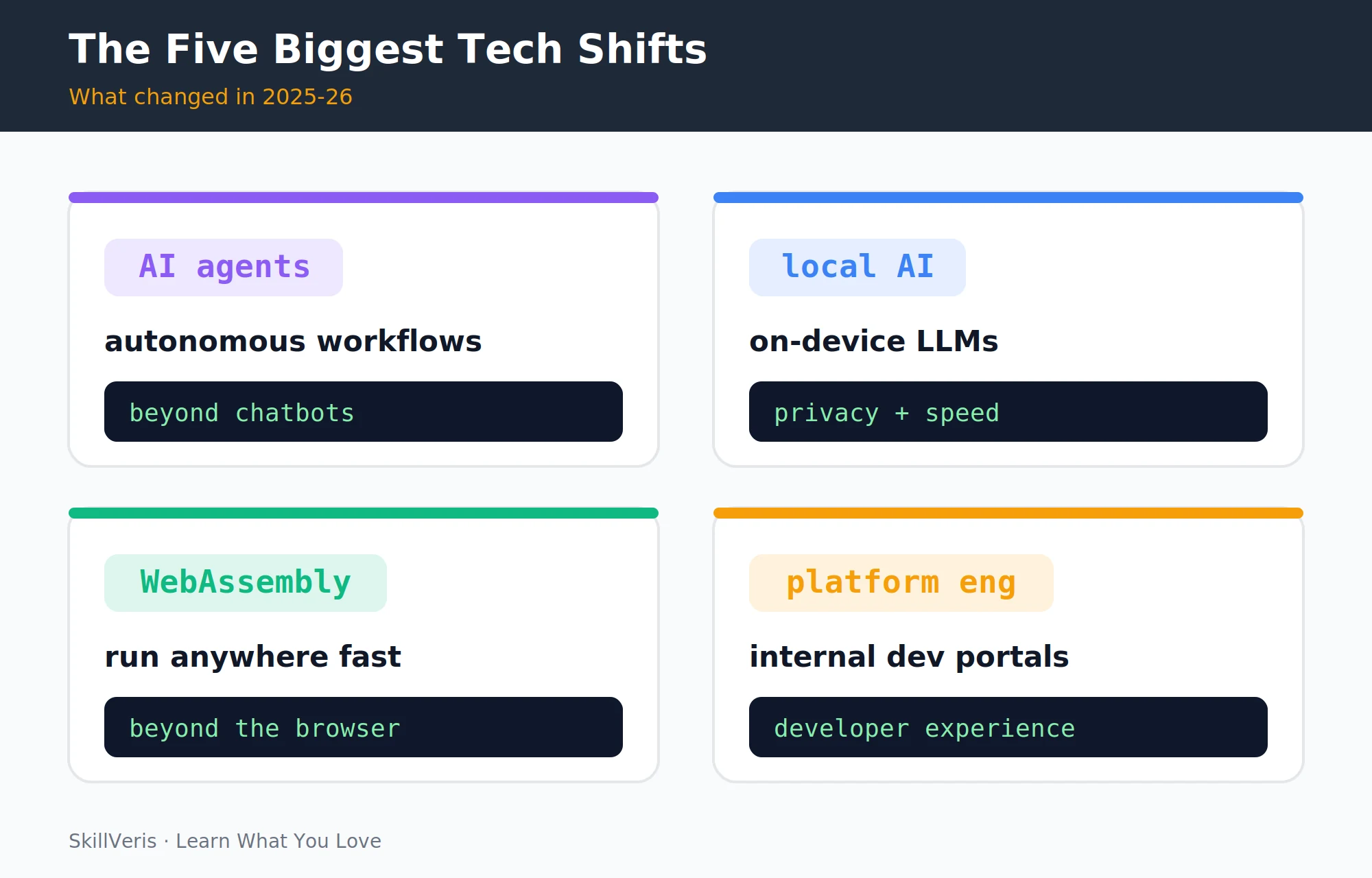
2023–2024 was the era of chatbots; 2025–2026 is the era of agents. Companies are deploying AI systems that autonomously handle multi-step workflows: end-to-end customer support resolution, code review and PR generation, invoice processing, research synthesis, and sales qualification. The shift is from "AI answers questions" to "AI completes tasks."
What this means for developers: understanding the agent loop, tool use, prompt injection defence, human-in-the-loop design patterns, and evaluation of autonomous systems is becoming a core software engineering skill, not a specialisation.
3Trend 2: On-Device and Edge AI
LLMs that fit on a phone or laptop — once a novelty — are now production-grade. Apple's on-device intelligence (iPhone 16+), Qualcomm's NPU-accelerated inference on Android, and models like Phi-3.5 Mini and Llama 3.2 3B running locally via llama.cpp have made privacy-preserving AI a real choice, not a compromise.
Driver factors: latency (no round-trip to a server), privacy (data never leaves the device), cost (no API fees at inference time), and offline capability. For mobile developers, on-device model integration is becoming table stakes; for everyone else, it opens a new class of offline-first AI applications.
4Trend 3: Open-Source Models Reach Parity
The gap between open-source and proprietary frontier models has narrowed dramatically. By mid-2026, Llama 3.3 70B, Mistral Large 2, Qwen 2.5 72B, and Gemma 2 27B match or approach GPT-4o on most benchmarks and match Claude Sonnet on many coding and reasoning tasks.
The implication: companies that need data privacy, cost control, or customisation have viable open-source alternatives for most tasks. The surrounding ecosystem (Hugging Face, Ollama, vLLM, llama.cpp) has also matured, making deployment as straightforward as managed APIs for teams with the infrastructure knowledge.
5Trend 4: Platform Engineering Matures
Platform engineering — building internal developer portals, self-service infrastructure, and standardised deployment workflows — has moved from a large-company practice to a mid-market expectation. Tools like Backstage (Spotify's open-source IDP), Port, and Cortex help teams manage microservices, track dependencies, and standardise environments without the ops team becoming a bottleneck.
The signal: "platform engineer" and "developer experience engineer" are among the fastest-growing job titles in 2026. If you're interested in DevOps/SRE, platform engineering is the natural next step beyond individual CI/CD pipelines.
6Trend 5: WebAssembly Beyond the Browser
WebAssembly (Wasm) was originally a way to run high-performance code in browsers. In 2026, it's increasingly used server-side: Cloudflare Workers, Fastly Compute, and Fermyon Spin run Wasm modules at edge locations globally, giving sub-millisecond cold starts and portable, sandboxed execution. WASI is bringing the same portability to server and CLI contexts.
For most web developers, Wasm is still an advanced topic. It's worth watching: if you work with Cloudflare Workers or edge runtimes, Wasm knowledge is increasingly valuable.
7Trend 6: AI-Native Developer Tools
The IDE of 2026 is not the IDE of 2022. AI assistance has moved from inline autocomplete to agentic coding: Cursor, Claude Code, and similar tools read entire codebases, propose multi-file refactors, write tests, explain complex code, and fix CI failures autonomously. The mental model of "the developer writes every line" is being replaced by "the developer reviews and directs AI output."
This creates a new premium skill: the ability to critically evaluate AI-generated code, write precise specifications, and direct AI tools effectively. Developers who treat AI coding tools as a replacement for understanding code will struggle; those who use them as a force multiplier on solid fundamentals will thrive.
8Trend 7: Evaluation Becomes a Discipline
As AI moves into production, the question "is this AI system working?" has become as important as "does this code compile?" Evaluation engineering — designing test sets, automated LLM-as-judge scoring, human evaluation protocols, and production monitoring for AI systems — is emerging as a distinct discipline within AI engineering teams.
The tooling is maturing too: LangSmith, Langfuse, Braintrust, and open-source frameworks like RAGAs. The core skill is the ability to define what "good" looks like in concrete, measurable terms — then build the infrastructure to measure it continuously.
9Trend 8: Cybersecurity Intensifies
AI has dramatically lowered the barrier to creating convincing phishing, deepfakes, and automated attack tools. At the same time, AI-powered defences are improving threat detection and response. The net effect in 2026: cyberattacks are more frequent, more sophisticated, and more automated — while the defender's toolkit has also grown.
Developers are directly affected: secure coding practices, dependency scanning, secrets management, and the OWASP Top 10 are no longer just the security team's concern. DevSecOps — integrating security into the development pipeline — is standard practice at most companies that have experienced a breach.
10What These Trends Mean for Your Career
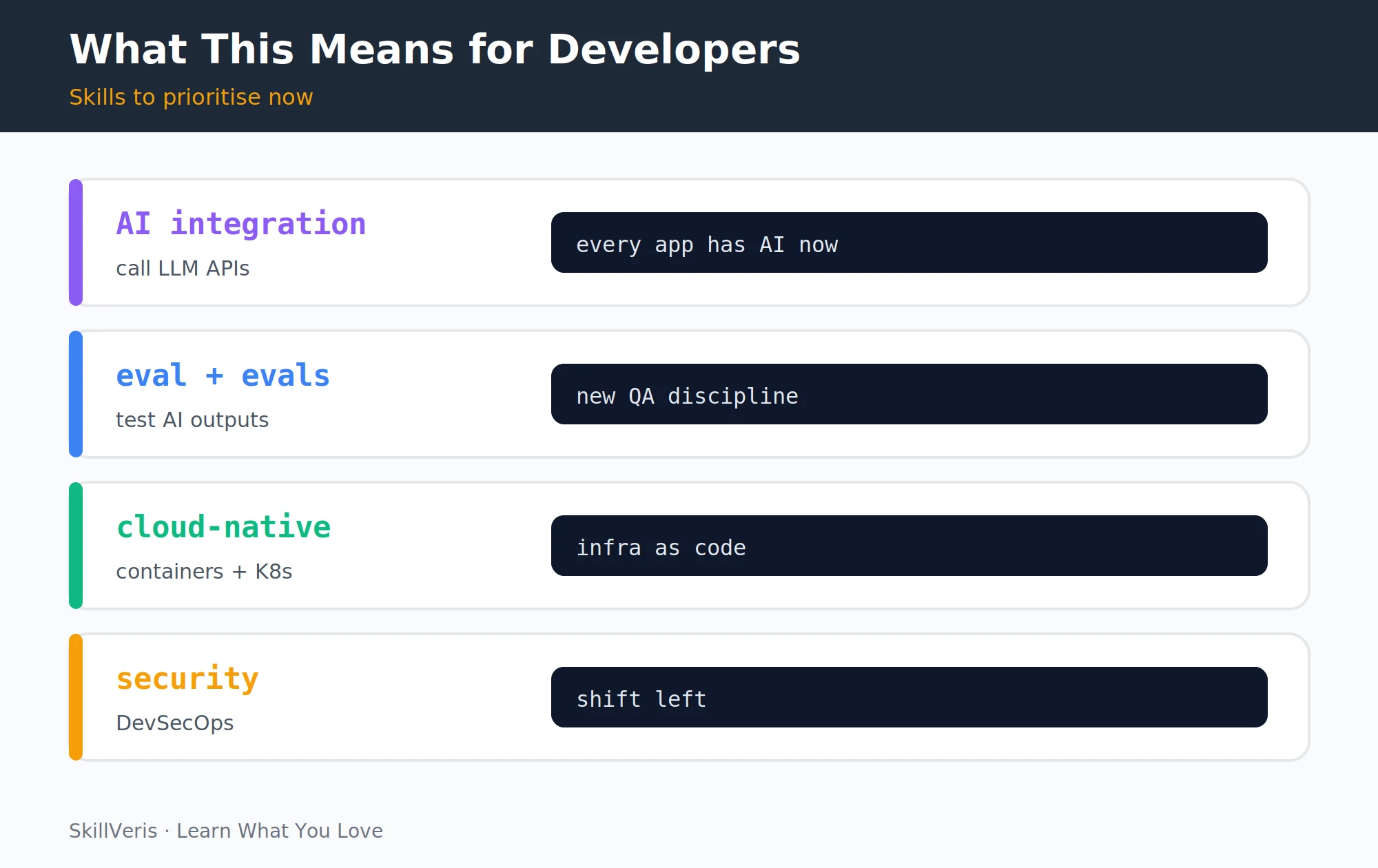
Each major trend maps to a concrete skill working developers can build now.
- AI agents in production — Agent design, tool calling, eval, safety
- On-device AI — Model quantisation, llama.cpp, mobile ML integration
- Open-source models — Hugging Face, vLLM, fine-tuning, self-hosting
- Platform engineering — Internal developer portals, service catalogues, Backstage
- AI-native dev tools — Effective AI tool use, code review, specification writing
- Evaluation discipline — Eval frameworks, LLM-as-judge, production monitoring
- Cybersecurity intensification — OWASP Top 10, DevSecOps, dependency scanning
11Skills to Prioritise Right Now
If you're early in your tech career in 2026, these skills have the clearest near-term demand signals.
- AI integration: calling LLM APIs, building RAG systems, basic agent patterns. Every product team is adding AI; people who can implement it are in demand everywhere.
- Cloud and DevOps fundamentals: Docker, CI/CD, Linux, one cloud provider. Infrastructure skills compound over time and are required for deploying any of the above.
- Python: remains the lingua franca of AI, data, and automation. If you only learn one language, make it Python.
- Security awareness: know the OWASP Top 10, practice secure coding, understand authentication flows. Every developer is a security practitioner now.
12Key Takeaways
The 2026 landscape rewards developers who blend AI fluency with strong engineering fundamentals.
- AI agents in production are the defining shift of 2026 — not just chatbots but autonomous task completion.
- On-device and open-source models give developers real alternatives to proprietary APIs for privacy-sensitive applications.
- Platform engineering and evaluation engineering are emerging as distinct, in-demand specialisations.
- The developer skill premium in 2026 is on AI integration, cloud-native deployment, and security awareness.
13What to Learn Next
Turn these trends into action with the skills that underpin them.
- AI Agents Explained — master the biggest trend of 2026.
- Docker for Beginners — container skills underpin cloud-native development.
- Cybersecurity for Beginners — security is every developer's responsibility now.
14Frequently Asked Questions
Will AI replace most developer jobs by 2027? The evidence so far suggests AI tools raise developer productivity rather than eliminate the role. The areas most affected are low-complexity, well-specified tasks: boilerplate, basic CRUD apps, simple data transforms. Complex system design, novel problem-solving, stakeholder communication, and evaluating AI output remain human-intensive — and developers who adapt are seeing demand increase, not decrease.
What is platform engineering and how is it different from DevOps? DevOps is a culture and practice of integrating development and operations. Platform engineering is a team that builds internal products — self-service deployment pipelines, service catalogues, observability tooling — that the rest of the organisation uses. Platform engineers are DevOps practitioners who have productised their work for internal customers.
Should I learn a specific open-source LLM or stick to APIs? Learn APIs first (Anthropic, OpenAI) — faster to get started, fewer infrastructure concerns. Add open-source model skills (Hugging Face, Ollama, fine-tuning) once you need on-device deployment, cost reduction at scale, or fine-tuning for your domain. The two skill sets are complementary, not competing.
Is WebAssembly worth learning for a typical web developer? For most web developers in 2026, Wasm is not an immediate priority. Learn it if you work with performance-critical browser applications (games, image/video editing, scientific computing), edge computing platforms like Cloudflare Workers, or Rust/C++ code you want to run in the browser. For general web development, JavaScript and TypeScript still cover 95% of needs.
Get The Print Version
Download a PDF of this article for offline reading.
About the Publisher
SkillVeris Team
Editorial Team
Curated, context-rich coverage of the tech stories that matter most for learners.
View all postsRelated Posts
Never miss an update
Get the latest tutorials and guides delivered to your inbox.
No spam. Unsubscribe anytime.