What Is Computer Vision? Real-World Examples
SkillVeris Team
AI Research Team
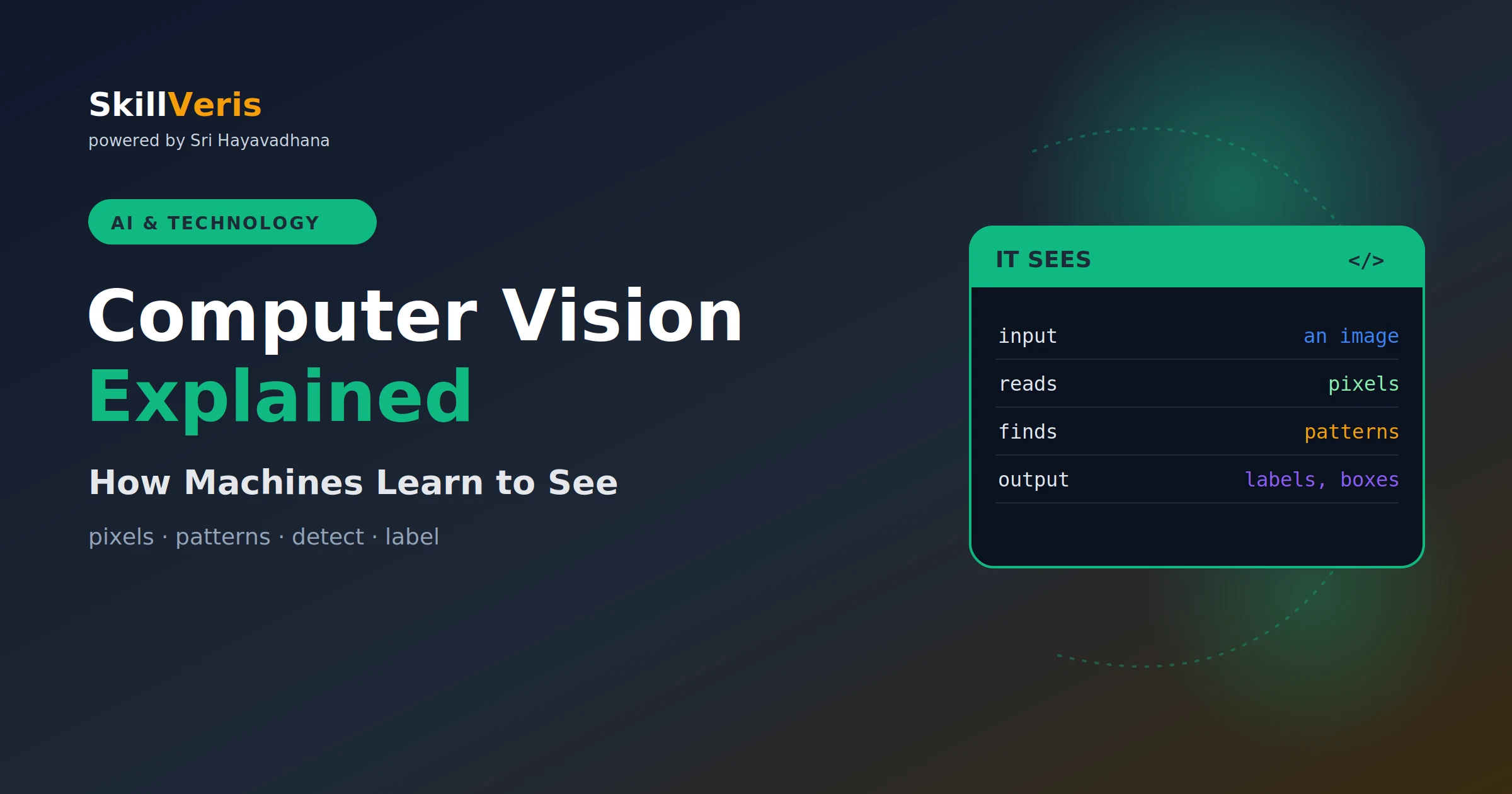
Computer vision is AI that interprets images and video
In this guide, you'll learn:
- To a computer an image is just a grid of pixels; vision models learn patterns in those pixels to perform tasks like classification (what is it?), detection (where is it?), and reco
- It already powers phones, medicine, cars, and retail.
- All concepts are explained with real-world examples and hands-on practice.
- All concepts are explained with real-world examples and hands-on practice.
1About This Guide
Your phone unlocks with your face, sorts photos by who's in them, and reads text from a picture. That's
computer vision. This guide explains how machines learn to "see" — without the maths. By the end you'll
2What Is Computer Vision?
Computer vision is the field of AI that teaches machines to interpret images and video — to identify
objects, read text, recognise faces, and understand scenes. It's how software turns raw pixels into
3How Computers 'See' an Image
To a computer, an image isn't a picture — it's a grid of numbers. Each pixel is a value (or three, for
colour). A vision model works entirely with these numbers, learning which patterns of pixels correspond to
4How Vision Models Learn
Vision models learn from huge collections of labelled images. Shown thousands of cats labelled "cat", a
model gradually learns the patterns that make a cat a cat. Modern systems use neural networks that
5Task 1: Image Classification
The simplest task: given an image, say what it is — "this is a dog", "this scan looks normal". The model
6Task 2: Object Detection
A step further: find where objects are, drawing boxes around each and labelling them. This is what lets a
7Task 3: Segmentation
More precise still: label every pixel, outlining exactly which pixels belong to which object. It's used in
medical imaging and photo-editing tools that separate a subject from its background.
- Phones: face unlock, photo search, scanning documents.
- Medicine: helping spot issues in scans and x-rays.
- Vehicles: reading the road for driver assistance and self-driving.
- Retail: automated checkout and shelf monitoring.
- Learn Python and the basics of machine learning first.
Related Reading
Get The Print Version
Download a PDF of this article for offline reading.
About the Publisher
SkillVeris Team
AI Research Team
Our AI team covers the latest in machine learning, generative AI, and emerging tech — clearly and accurately.
View all postsRelated Posts
Never miss an update
Get the latest tutorials and guides delivered to your inbox.
No spam. Unsubscribe anytime.